So the 2010 edition of the U.S. Chess Championship came down to the following tie break game! Kamsky had 25 minutes on his clock against Yuri Shulman who had 6o minutes - both with a five seconds delay. Talk about an exciting finish to this year's event!
Odd time control, eh? It certainly is - but this was a tie break game to determine who alone would claim the title of United States Chess Champion as both players were tied on 6.5 each. This format of tie break is known as an "Armegodden" game - where the player of the White pieces gets more time and MUST win the game to win the match while the player of the Black pieces will get the "draw odds" which is to say that if they should draw it is treated as a win.
This year both players had to place a secret bid - the amount of time that they would be willing to accept as black - in order to get the Black pieces. The draw odds is a significant advantage! So both players wanted the Black pieces for this game... but Kamsky's bid was far lower than Shulman's and so he won the Black pieces.
Please make note - this is not a "normal" tournament chess game but a tie break. Normal chess would never feature such rules and the only reason why anyone would use such a tie break format is to balance the need for the event to finish up in a timely manner while still allowing both players to battle it out for first - winning it upon their own merits.
Here now is this exciting game!
In the final position Gata Kamsky achieved a well known draw - that neither player felt the need to play out as it was too obvious for both of them. Gata managed to do this with only seconds remaining upon his chess clock! Next time - don't bid so low Gata!
This is the second time that Gata Kamsky has become US Champion - the last time was 19 years ago when he was still a teenager! Congratulations Gata Kamsky!
- Chess Coach Sean Tobin.
Friday, May 28, 2010

Monday, May 24, 2010
Tuesday, April 20, 2010
WEAK DIAGONALS and of BISHOPS & QUEENS!
This is a follow up lesson on our WEAK DIAGONALS and ANNOYING QUEEN CHECKS lesson. Enjoy!
Jason Bell versus Sean Tobin

WHO IS PLAYING THE WHITE PIECES HERE?

4. Nfd2 Bd6
The second player looks to exploit the b8 to h2 dark diagonal. WHERE HAVE WE ALL SEEN THIS IDEA BEFORE - AHEM!

5. f3??
This move is now a terminal weakness that will result in the first player losing the game. The idea here was to dissolve the second player's center but overlooks black's control of the b8 to h2 diagonal. Can you find Chess Coach Sean's reply? : P

5... Qh4+
Ah-ha! THE POWER OF THE ANNOYING QUEEN CHECK - one of the best ways to take advantage of a really weak diagonal!! A move obviously overlooked by the first player. Now White is lost as his King is blocked in by his own pieces and can be attacked along the h4 to e1 diagonal with dire consequences. Dire consequences = checkmate!!!!!!!!!!!!!!!!!

6. g3 BOX
BOX equals only move - you have just got to love those silly INFORMATOR CODES! When our King is in check we must either 1. Capture the offending piece; 2. Block the check or 3. Move away. Here only option two is available.
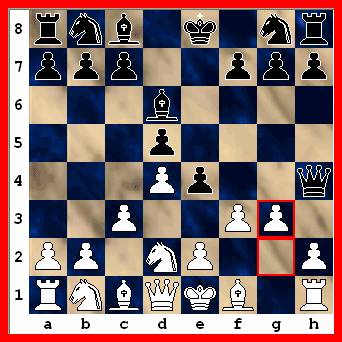
BLACK TO PLAY AND WIN
WHAT'S THE BEST MOVE?
6... Qxg3+!
THAT IS NO WAY TO TREAT A LADY - WAIT, ACTUALLY IT IS! Either piece could have made the capture on g3 but I - Chess Coach Sean - obviously wanted to deliver mate with the Bishop! Thus forcing option numeral uno!!


Attention passengers - Flight 0-1 checkmate has arrived! Thank you for flying CHESS!
FINAL POSITION
0 - 1
Jason Bell versus Sean Tobin
DESCHUTES COUNTY CHESS CLUB 05 08 2006
JASON BELL VS SEAN TOBIN:
[Event:"Casual Chess Game"]
[Site:"Redmond Public Library; 827 SW Deschutes Avenue; Redmond OR. 97756"]
[Date:"05.08.2006"]
[White:"Bell, Jason"]
[Black:"Tobin, Sean"]
[Opening:"Saragossa Opening"]
[ECO:"A00"][NIC:"VO.12"]
[Time Control:"None used"]
1. c3
This is known as the Saragossa opening... not the best way to seize the center! Such an opening would not be played by our players - nor by chess coach Sean!
1... e5
If given the opportunity Black/the second player should play as though he/she is at the helm of the White pieces! Plant that flag in the center of the board!

WHO IS PLAYING THE WHITE PIECES HERE?
2. d4
1. c3 was the "slow build up" to 2. d4. Not a bad strategy though. People can and do play the Saragossa opening to win and do so. This is just not the best way to make use of the initiative nor is it the best way to control the center.
2... d5
Gambit anyone?
3. Nf3 e4
The second player should grab some space now as otherwise he could just regret having offered the gambit pawn! The idea behind this move is to cramp Jason Bell's chess style! The pawn on e4 will create all sorts of problems for members of the opposing White Army.

4. Nfd2 Bd6
The second player looks to exploit the b8 to h2 dark diagonal. WHERE HAVE WE ALL SEEN THIS IDEA BEFORE - AHEM!

5. f3??
This move is now a terminal weakness that will result in the first player losing the game. The idea here was to dissolve the second player's center but overlooks black's control of the b8 to h2 diagonal. Can you find Chess Coach Sean's reply? : P

5... Qh4+
Ah-ha! THE POWER OF THE ANNOYING QUEEN CHECK - one of the best ways to take advantage of a really weak diagonal!! A move obviously overlooked by the first player. Now White is lost as his King is blocked in by his own pieces and can be attacked along the h4 to e1 diagonal with dire consequences. Dire consequences = checkmate!!!!!!!!!!!!!!!!!

6. g3 BOX
BOX equals only move - you have just got to love those silly INFORMATOR CODES! When our King is in check we must either 1. Capture the offending piece; 2. Block the check or 3. Move away. Here only option two is available.

BLACK TO PLAY AND WIN
WHAT'S THE BEST MOVE?
6... Qxg3+!
THAT IS NO WAY TO TREAT A LADY - WAIT, ACTUALLY IT IS! Either piece could have made the capture on g3 but I - Chess Coach Sean - obviously wanted to deliver mate with the Bishop! Thus forcing option numeral uno!!

QUEEN SAC!
7. hxg3 Bxg3 checkmate!
A very instructive game.
A very instructive game.

Attention passengers - Flight 0-1 checkmate has arrived! Thank you for flying CHESS!
FINAL POSITION
0 - 1
Friday, April 9, 2010
Monday, March 22, 2010
My "FORK" Game - a fun game from a long time ago!
Tobin, Sean - Moore, Craig
2007.01.20, ECO: C84
A fun game played against a friend - a good way to pass some time! - Coach Sean.
Tuesday, February 9, 2010
Friday, February 5, 2010
ALL THE MOVES - HOW YOU CAN MOVE YOUR PIECES & PAWNS by Coach Sean
IN THIS LESSON YOU WILL LEARN HOW

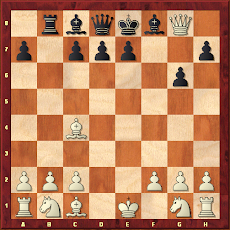
Up above we have the start position for a game of chess. The Rooks are in the corners, next come the Knights, and then we have the Bishops and then finally we have our royalty. The trick to remembering which square the King and Queen stand upon is this:
When you place a chess board down make sure that you always have "LIGHT ON RIGHT" - that is to say a white square in the right hand corner. Otherwise you will have inverted the 64 square universe and now the set up will be different as the Bishops and the other pieces will stand on the opposite colored squares that they should be. So it is always "LIGHT ON RIGHT".
In the start position given up above the pieces and pawns are worth the following points:
Down below you will find board positions that show you how to move the pieces and pawns. The circles will be used to show how pieces look at and travel upon diagonal squares - or how they even attack them. The red arrows will show you how to move along the files and Ranks.
THE PAWNS:
 KNIGHTS:


Bishops are one of three "Line Pieces" or as Chess Emporium Chess Coaches like to refer to them - "Laser Beam Pieces".
BISHOPS:

ROOKS:
 Rooks are one of three "Line Pieces". Or as Chess Emporium Chess Coaches like to refer to them - "Laser Beam Pieces".


Queens are one of three "Line Pieces". Now you know that the QUEEN, ROOK and BISHOP are the three laser beam pieces! When playing with one of these three pieces - or with all of them - remember to always draw a line or lines out from where these pieces stand and follow those lines until you can see what these pieces are looking at. This is always a good safety check - but it takes some self discipline to avoid allowing "Cobra hand" to strike the pieces down.
QUEENS:


KINGS:
Thank you for having taken the time to read this posting - I hope it has helped you! If you have any questions then please do contact me on my personal cell phone. If I do not pick up then please do leave a message and I will return your call within twenty four hours.
Yours in Chess
Coach Sean Tobin.
- TO MOVE PIECES.
- TO MOVE PAWNS
- WHAT A FILE IS
- WHAT A RANK IS
- WHAT A DIAGONAL IS
- WHAT EACH PIECE & PAWN IS WORTH AT THE START OF A GAME.
- WHY YOU WANT TO HAVE YOUR PIECES CONTROL THE CENTER OF THE BOARD
- THE STRENGTH OF OUR PIECES - IN THE CENTER vs THE SIDE OF THE BOARD.

Up above we have the start position for a game of chess. The Rooks are in the corners, next come the Knights, and then we have the Bishops and then finally we have our royalty. The trick to remembering which square the King and Queen stand upon is this:
- QUEEN ON HER OWN COLOR
- HER DRESS MATCHES HER SHOES.
When you place a chess board down make sure that you always have "LIGHT ON RIGHT" - that is to say a white square in the right hand corner. Otherwise you will have inverted the 64 square universe and now the set up will be different as the Bishops and the other pieces will stand on the opposite colored squares that they should be. So it is always "LIGHT ON RIGHT".
In the start position given up above the pieces and pawns are worth the following points:
- PAWNS are worth 1 point.
- KNIGHTS are worth 3 points - or three pawns.
- BISHOPS are worth 3 points - or three pawns.
- ROOKS are worth 5 points - or one Bishop (or Knight) and two pawns.
- QUEENS are worth 9 points - or three Knights or three Bishops.
- KING is worth - the WHOLE GAME! Remember the whole point of a game of chess is to deliver checkmate against your opponent's King.
Down below you will find board positions that show you how to move the pieces and pawns. The circles will be used to show how pieces look at and travel upon diagonal squares - or how they even attack them. The red arrows will show you how to move along the files and Ranks.

THE PAWNS:
- Pawns can move one OR two squares on the first move.
- After that only one move per customer please!
- Each pawn can move 1 or 2 squares on it's first move.
- Pawns are tricky characters - they run out onto the battle field and hope to be promoted to a higher rank some day. Pawns have two SPECIAL MOVES:
- PAWN PROMOTION - this is what can happen when a pawn gets to the other side of the board. It can then become either a QUEEN, ROOK, KNIGHT or BISHOP - but only one of these four pieces. If you were to promote all eight of your pawns you could have an additional eight queens on the board!
- EN PASSANT CAPTURE a.k.a. CAPTURE IN PASSING. A tricky move that allows attacking pawns to keep enemy pawns from escaping - from running on by them.
THESE MOVES WILL BE COVERED IN THE POSTING DOWN BELOW THIS ONE. RIGHT NOW LET US FOCUS ON THE MOVES OF THE PIECES AND PAWNS. - COACH SEAN.
KNIGHTS:
 KNIGHTS:
- Move by going up two squares and then over one.
- This Knight - in both positions given - can see all of the squares with circles on them.
- Knights move in an "L-shaped" pattern.
- Knights land on a square that is the opposite color of the square that they stood upon. E.g. A knight on the f3-square (Position given above) is on a white square but he now looks at green squares. We can also refer to the green squares as being dark squares.
- Stronger as they move towards the center of the board.
- Weak in corners.
- "Asymmetrical" warriors - they can attack pieces that cannot block the attack. This makes them very dangerous attackers.
- The only pieces that can jump over other pieces - both our own and our opponents.

BISHOPS:

Bishops are one of three "Line Pieces" or as Chess Emporium Chess Coaches like to refer to them - "Laser Beam Pieces".
BISHOPS:
- Move in a straight line along what we call "Diagonals".
- In the middle of an empty Chess Board this Bishop can look at up to 13 square - X marks the squares!
- Every square that this Bishop looks at has a circle upon it. If anything should step onto one of these squares then the Bishop will be looking at that piece.
- If a piece stands on a square that is being looked at by a Bishop then the Bishop cannot see the squares behind that piece.
- Bishops MUST stay on the color of the square that they start out on. A White dark-squared Bishop can never "change lanes" and become a light-squared Bishop. That is a no-no!
- One of three Line Pieces - they move in a straight line, along their line of sight.
- Strongest in the center of the board. Here they can see 13 squares.
- Weakest in the corners - they can only see 7 squares.
- a serious advantage if you have a "PAIR" of them. This is known as "The BISHOP PAIR".
- Unable to jump over other pieces. As with any capture we land upon the square that the enemy piece stands upon - putting our piece onto this square - and removing our opponent's piece from that square and then placing it at the side of the board.

ROOKS:
 Rooks are one of three "Line Pieces". Or as Chess Emporium Chess Coaches like to refer to them - "Laser Beam Pieces".
- Move in a straight line along what we call "FILES and RANKS".
- Every square that this ROOK looks at has a red arrow running through it. If anything should step onto one of those squares then the Rook will be looking at that piece.
- If a piece or a pawn stands upon a square that is being looked at by a Rook then the Rook cannot see the squares behind that piece.
- Rooks have four pairs of eyes in the center of the board. They are a unique piece in that even though they have fewer pairs of eyes when they are in the corner of the board they can still see the same number of squares.
- One of three Line Pieces - they move in a straight line, along their line of sight.
- Strongest in the center of the board. Here they can see 14 squares on an empty board.
- Can see the same number of squares - no matter where you place them upon an empty chess board. Give it a try and count the squares.
- In the middle of the Board a rook has four pairs of eyes - so you cannot sneak up on him by stepping onto a File or Rank. In a corner the Rook has only two pairs of eyes - but he doesn't need the other two pairs because no one can sneak up on him from off beyond the board.
- Are strongest when they have open files or ranks down which to look and move.
- Unable to jump over other pieces. As with any capture we land upon the square that the enemy piece stands upon - putting our piece onto this square - and removing our opponent's piece from that square and then placing it at the side of the board.
- Rooks are strong pieces that can "own" files if they have "won" from enemy pieces and pawns. Of course we should not have any pawns on such a file if our Rooks are to be able to see as far as they possibly can.

QUEENS:

Queens are one of three "Line Pieces". Now you know that the QUEEN, ROOK and BISHOP are the three laser beam pieces! When playing with one of these three pieces - or with all of them - remember to always draw a line or lines out from where these pieces stand and follow those lines until you can see what these pieces are looking at. This is always a good safety check - but it takes some self discipline to avoid allowing "Cobra hand" to strike the pieces down.
QUEENS:
- Move in a straight line along what we call "FILES and RANKS" - just like ROOKS. BUT they can also move like BISHOPS - along files.
- The Queen is the strongest chess piece on the board.
- On an empty chess board the Queen in the middle of the board can look at up to 27 squares. We never count the square a piece stands upon - I can hear some of my students saying "No - 28" already! : P
- Every square that this Queen can look, on the ranks and files, has a red arrow running through it. For the squares along the diagonals that she can see I have placed circles. If anything should step onto one of those squares then the Queen will be looking at that piece.
- If a piece or a pawn stands upon a square that is being looked at by a Queen then the Queen cannot see the squares behind that piece.
- Like all of the pieces - except for the Rook - the Queen has the best view of an empty chess board in the middle of the board. But just like all of the other pieces the Queen can only see fewer squares when she stands in a corner. The Rook is different because he/she/it can see the same number of square no matter where you place this piece on an empty chess board.
- In one of the four corner squares the Queen can only see 21 squares.
- One of three Line Pieces - they move in a straight line, along their line of sight.
- Strongest in the center of the board. Here they can see 27 squares on an empty board.
- See fewer squares when standing upon a1, a8, h1 or h8 squares.
- In the middle of the Board a Queen has eight pairs of eyes - so you cannot sneak up on this piece! In a corner the Queen only has three pairs of eyes - what a strange looking lady. Is she from the Chernobyl region of the Ukraine?
- Are strongest when they have open files, ranks and diagonals down which to look and move.
- Unable to jump over other pieces. As with any capture we land upon the square that the enemy piece stands upon - putting our piece onto this square - and removing our opponent's piece from that square and then placing it at the side of the board.
- Queens are strong pieces that can "own" files, ranks or diagonals if they have "won" them from enemy pieces and pawns.
- We should avoid playing the Queen out early during the opening as she can be easily attacked by what are called the minor pieces (Bishops and Knights).
- Here is an easy mnemonic device to help us remember that we do not - usually - as a rule of thumb want to move the Queen out early : "Move your Queen out early - lose her in a hurry!".

KINGS:

KINGS:
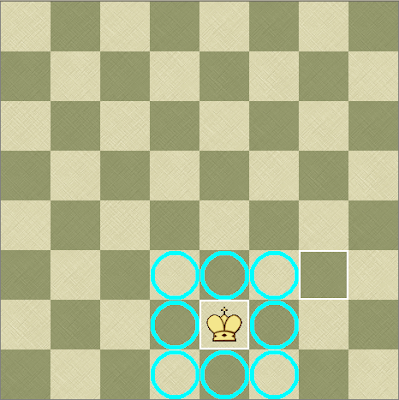
- Can move one square in any direction.
- This King - in both positions given - can see all of the squares with circles upon them.
- The King is the old man of the chess board.
- Kings cannot use other pieces to block checks from Knights - because Knights can land on a square that is the opposite color of the square that they stand upon. So when our opponents start to bring their Knights closer to our King we have to be careful!
- The King has a special move - it is called Castling. See the posting on Special moves for more on this.
- The King is the cowardly old man of the chess board - he hides in his throne room and has every one else do the fighting. Once we get into the endgame - and you will know when you have reached the endgame because there will not be many pieces left on the board - then the King comes out to fight! In the endgame the King is a fighting piece.
- We never want our King to lead the charge into battle - this is a bad idea!
- Stronger as they move towards the center of the board - as soon as they step away from the side of the board.
- Weak no matter what square they stand upon - our opponent always wants to trap this piece with his pieces and pawns!
- Only as fast as a pawn. If you King is behind an enemy pawn he will never catch it.
- Able to capture enemy pieces - just like any other piece can UNLESS - that piece is protected by one of it's friends.
- When our King is in CHECK - being looked at by an enemy piece - we must look at the following list of potential options:
- The King is the "old man" of the chess board - he does not move very quickly.
- Capture the attacking piece.
- Block the attack by putting one of the Kings loyal subjects in the way.
- Run away from the check! I told you - the King is cowardly!
- CHECK
- CHECKMATE and
- STALEMATE

Thank you for having taken the time to read this posting - I hope it has helped you! If you have any questions then please do contact me on my personal cell phone. If I do not pick up then please do leave a message and I will return your call within twenty four hours.
Yours in Chess
Coach Sean Tobin.
Subscribe to:
Posts (Atom)